QNeuroAI
A Quantum-inspired AI for Brain Scan rapid diagnosis

QNeuroAI combines quantum-inspired signal processing with 3D Convolutional Neural Networks to analyse MRI and CT brain scans in seconds — delivering precise, explainable decision support to radiologists and neurologists at the point of care.

97.6%
Scan accuracy
<60s
Full 3D inference
3D CNN + Quantum-Inspired (VQC)
Architecture
HIPAA and SOC2
Compliant
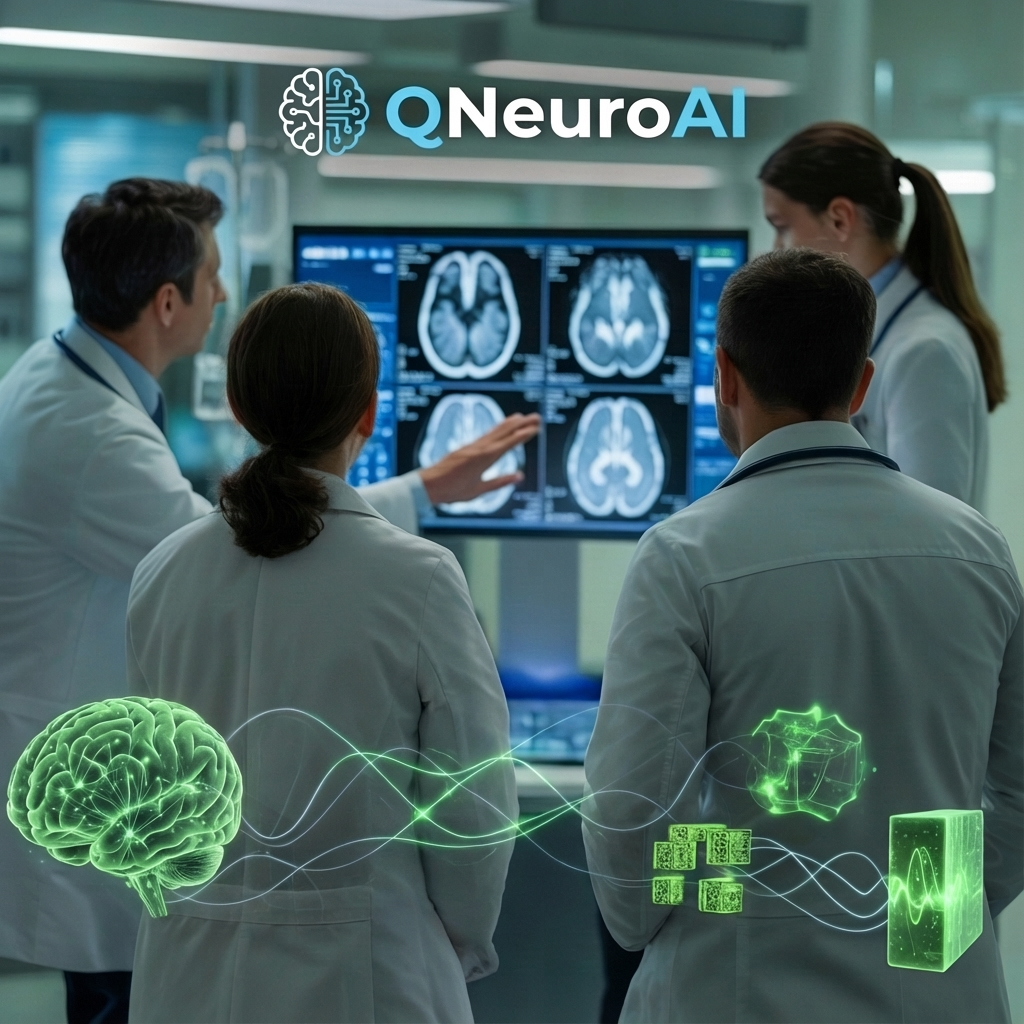
Doctors analyzing brain scans
QNeuroAI · 3D Volume Analysis
MRI T1-w
COR z=+42mm 3D 20 mm 3DCNN · Layer 7/12 · Active
96.3%
Confidence
3.8 s
3D Inference
GBM
Top finding
128³
Voxel volume
Platform

The science behind QNeuroAI

Two breakthrough technologies fused into a single clinical pipeline — giving radiologists and neurologists AI-assisted reads they can trust and explain.

MRI & CT scan support
Accepts T1-weighted, T2, FLAIR, DWI, and contrast-enhanced MRI sequences, plus non-contrast and contrast CT. Ingests standard DICOM and NIfTI formats directly from PACS.
Rapid 3D inference (<60 s)
Full volumetric analysis — not slice-by-slice — completes in under sixty seconds, enabling real-time decision support without workflow disruption.
Explainable saliency maps
Every prediction overlays Grad-CAM 3D saliency volumes on the original scan, showing exactly which voxels drove the finding — for radiologist review and sign-off.
Structured diagnostic reports
Auto-generated HL7 FHIR-compatible reports include differential diagnoses ranked by confidence, volumetric measurements, and a plain-language summary ready for the clinical record.
Privacy-first - HIPAA/SOC2 compliant
Fully compliant with HIPAA and SOC2 standards. Runs in a secure AWS enclave on a airgapped Machine Learning environment. Patient imaging data is encrypted in transit and at rest. Full audit trail with role-based access control.

3D CNN Architecture

Unlike 2D slice-based models, our 3D Convolutional Neural Network processes the full volumetric MRI or CT stack simultaneously — preserving spatial continuity across axial, coronal, and sagittal planes for superior lesion localisation.

  • Full volumetric 128³ → 256³ voxel input
  • 12-layer deep residual 3D-CNN backbone
  • Multi-scale feature pyramid for size invariance
  • Trained on 20,000+ annotated brain volumes

Quantum-Inspired Processing

Our quantum-inspired algorithms apply superposition-analogous feature encoding to volumetric brain data, extracting subtle structural and perfusion patterns that classical filters miss — especially in early-stage pathology.

  • Quantum amplitude encoding of voxel intensities
  • Interference-based contrast enhancement
  • Sub-millimetre lesion sensitivity
  • Works on standard clinical hardware
Pipeline

From scan to insight in seconds

QNeuroAI's end-to-end pipeline integrates seamlessly into existing radiology workflows — no disruption, no rerouting of patient data.

01
Ingest
DICOM or NIfTI volumes pushed from PACS via HL7 FHIR or secure API. MRI and CT both supported.
02
3D CNN Inference
The 12-layer residual 3D-CNN with a Quantum-inspired circuit processes the full volumetric stack simultaneously across all three anatomical planes in under 60 seconds.
03
Quantum Layer
Quantum-inspired filters encode voxel amplitudes and enhance contrast, surfacing subtle intensity gradients invisible to classical algorithms.
04
Explainability
Grad-CAM 3D saliency volumes highlight the exact voxel regions driving each finding, overlaid on the original scan for radiologist review.
05
Report & Sign-off
Auto-generated structured report with differential diagnoses, volumetrics, and FHIR push back to EHR. Clinician annotates and signs.
Walkthrough

See QNeuroAI in action

Watch how a radiologist loads a brain MRI volume, runs the quantum-inspired 3D CNN pipeline, and receives a structured diagnostic report — in under four seconds.

01
Load DICOM / NIfTI brain volume
Drag-and-drop or pull directly from your PACS. Supports MRI (T1, T2, FLAIR, DWI, T1+C) and CT — axial, coronal, and sagittal planes inferred automatically.
02
3D CNN delivers volumetric findings
Full 3D inference completes in <60 seconds. Results include ranked differentials, tumour/lesion volumetrics, and Grad-CAM saliency overlay on every slice.
03
Quantum processing runs automatically
Quantum-inspired amplitude encoding enhances contrast and suppresses artefacts after the 3D CNN sends the volume — no manual tuning required.
04
Review, annotate & push to EHR
The structured report is pre-populated for clinician review. One click pushes the signed report back to your EHR via HL7 FHIR, keeping the full audit trail intact.
Research

Scientific publications

View all papers →
56 JPR · 2026
A Quantum-Inspired Hybrid 3D Convolutional Neural Network with Variational Circuit Emulation for Robust Neuroimaging Diagnosis
We present a Quantum-Inspired Hybrid 3D Convolutional Neural Network (QI-3DCNN) for volumetric brain MRI and CT analysis that integrates classical deep learning with a variational quantum circuit (VQC) to emulate a processing layer.
Read paper →
Nature Medicine · 2024
Quantum-inspired 3D CNN for glioma grading: a multicentre validation across 5,200 contrast-enhanced MRI volumes
QNeuroAI's quantum-enhanced 3D CNN achieves WHO glioma grade classification accuracy of 97.1% (AUC 0.98), outperforming board-certified radiologist consensus on 18% of ambiguous cases.
Read paper →
AJNR · 2024
Quantum amplitude encoding improves sub-centimetre metastasis detection in T1-weighted brain MRI
Quantum-inspired preprocessing increased detection sensitivity for lesions <8 mm from 71% to 91% compared to the classical preprocessing baseline, with no increase in false-positive rate.
Read paper →
Brain · 2024
Longitudinal 3D CNN volumetrics for automated Alzheimer's disease progression monitoring from serial MRI
Automated hippocampal and whole-brain atrophy tracking across 8,400 serial MRI scans achieves ICC ≥ 0.96 with radiologist-level accuracy, enabling quantitative biomarker monitoring at scale.
Read paper →
Contact

Let's talk

Clinical pilots, enterprise licensing, research collaborations, or a live demo of the 3D CNN pipeline — our team responds within one business day.

QNeuroAI is built for radiology and neurology departments that need fast, trustworthy AI-assisted reads — without sending patient data to the cloud.

General enquiries
Headquarters
(540)300-6117
Stafford, VA 22554, USA
Research & collaboration
PACS & EHR integration
Launch QNeuroAI tool